Norwegian Sauna Culture — A Complete Guide for First-Time Visitors
Everything tourists need to know about sauna culture in Norway — from etiquette and traditions to the best experiences across the country.
The sauna is not a novelty in Norway. It is not a spa accessory or a wellness trend. It is a piece of infrastructure, as basic to Norwegian life as the kitchen or the bedroom. Norwegians have been gathering in saunas — called “badstue” — for centuries, and the traditions around this gathering are specific, unspoken, and deeply felt.
For visitors, stepping into a Norwegian sauna for the first time can be a slightly bewildering experience. The heat is higher than anything you may have encountered in a hotel gym. People are often naked. Conversation is quieter than you might expect. And at some point, almost everyone will get up, walk outside, and jump into whatever cold water is available nearby.
This guide explains everything you need to know to approach Norwegian sauna culture with confidence, respect, and the kind of curiosity that makes travel memorable.
A Brief History of Sauna in Norway
The sauna tradition in Norway predates written history. Archaeological evidence suggests that early Norse settlements included dedicated bathing structures — smoke saunas heated by open fires, where the entire room filled with smoke before the fire was extinguished and the steam rose from superheated stones.
Through the medieval period, the “badstue” was the warmest and cleanest space on any farm or in any village. It was where people bathed, where women gave birth, where the sick were brought to sweat out fevers, and where the dead were washed before burial. The sauna was not leisure — it was life.
This functional role diminished as indoor plumbing arrived in the 20th century, but the cultural attachment remained. Today’s Norwegian sauna culture is the direct descendant of that ancient tradition: communal, unself-conscious, and rooted in a deep understanding of the relationship between heat, cold, and physical wellbeing.
The past decade has seen a genuine renaissance. Floating saunas have appeared in harbours across the country, architects are designing sauna pavilions as serious cultural statements, and a new generation of Norwegians has rediscovered the badstue as an antidote to screen time and indoor life. Visitors from all over the world are arriving specifically for the sauna experience — and Norway is happy to welcome them.
Types of Saunas You Will Find in Norway
Norwegian sauna culture has diversified considerably from its simple origins. Understanding the landscape helps you choose the right experience.
Floating Saunas
Perhaps the most photogenic of all Norwegian sauna types, floating saunas are wooden structures on pontoons moored in harbours, fjords, and lakes. They have become symbols of urban Norwegian outdoor culture, particularly visible in Oslo and Bergen, but now found all along the coast. KOK Oslo is one of Oslo’s most celebrated floating saunas, moored in the inner Oslofjord and booked out weeks in advance on weekends. Badstufergen near Lillehammer is one of the more unusual examples — a converted ferry sauna on Lake Mjøsa.
Wood-Fired Saunas
The traditional form. A wood-fired stove heats stones over several hours, and the quality of heat it produces — softer, more enveloping than electric heat — is something sauna enthusiasts argue is fundamentally superior. Farm saunas, wilderness saunas, and village communal saunas are most commonly wood-fired.
Barrel Saunas
A modern variation that has become extremely popular in Norway. Cylindrical in shape and usually made of Nordic pine, barrel saunas are compact, efficient to heat, and visually distinctive. They are common at cabin rentals and outdoor hospitality venues across the country.
Hotel and Spa Saunas
Major hotels in Norwegian cities and resort areas offer spa-quality sauna facilities, often combined with pools, steam rooms, and cold plunge pools. Britannia Spa in Trondheim represents the high end of this category — a grand hotel spa that incorporates traditional sauna principles into a luxury setting.
Communal Saunas and Sauna Associations
Perhaps the most authentically Norwegian institution: the local badstueforening, or sauna association. These member-run organisations maintain communal sauna facilities that are open to members and sometimes to the public. Bunker Sauna is a striking example — a sauna built into or near a former military structure, repurposed for community wellness use.
Wilderness and Adventure Saunas
For those willing to travel further, Norway offers sauna experiences in genuinely remote settings — accessible only by boat, ski, or long hike. Barents Sauna Camp at Bugøynes near the Russian border and SvalBad Svalbard in Longyearbyen represent the extremes of this category, where the sauna experience is inseparable from the extraordinary landscape surrounding it.
Sauna Etiquette — What to Expect
Norwegian sauna culture has clear, if mostly unspoken, norms. As a visitor, understanding them will make your experience more comfortable and more connected to the tradition you are participating in.
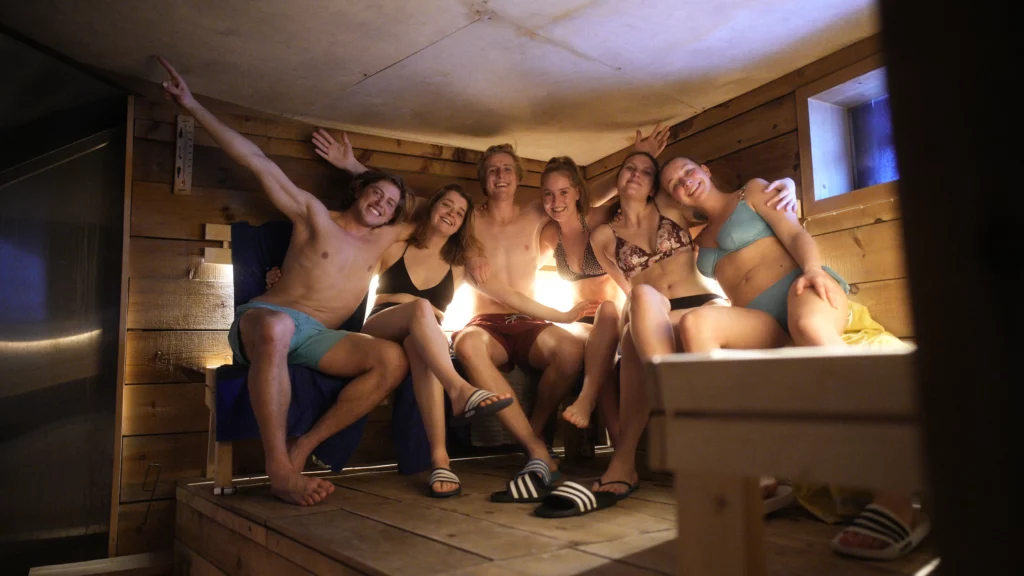
Nudity is normal in same-sex settings. In communal and traditional saunas, most Norwegians go without clothing. Swimwear is generally accepted and expected in mixed-gender public settings. If you are unsure, follow the lead of the people around you or ask the operator in advance.
Bring a towel. You will sit on it in the sauna — bare skin on hot wood is uncomfortable and unhygienic. It also serves as your wrap for the walk between sauna and water.
Silence is not unfriendly. The sauna is a place of rest. Quiet contemplation or low conversation is the norm; loud talk and phone use are not. Do not be surprised if people barely speak. It is not standoffishness — it is the culture.
The cold plunge is not optional (culturally). You do not have to go in the cold water, but you will be the only one who doesn’t. If you are physically able, try it at least once. The experience is the reason most Norwegians are there.
Shower before entering. In public and communal saunas, rinsing before you enter is standard hygiene practice.
Leave your phone in your bag. Photography in saunas is inappropriate unless everyone present consents. This is especially important in communal facilities.
Respect the heat. Do not pour excessive water on the stones. A single ladleful raises the temperature significantly. In a communal sauna, it is polite to ask if anyone objects before adding steam.
The Heat-Cold Ritual Step by Step
For first-timers, the Norwegian sauna session follows a recognisable structure.
Round one (10–15 minutes): Enter the sauna and settle at a comfortable bench level — lower is cooler, higher is hotter. Let your body adjust without adding steam. Breathe slowly and allow the heat to build. When you are sweating freely and feel the need for fresh air, it is time to exit.
The cold plunge: Walk calmly to the water and enter. If it is a cold water pool, lower yourself steadily rather than jumping. In open water — the sea, a lake, a river — adjust to the local entry conditions. Stay for 30–90 seconds, breathe steadily, then return to the sauna or rest area.
Rest period: Sit outside the sauna (or in an anteroom if there is one) and let your body temperature normalise. This period is important — it is when much of the physiological benefit of the contrast cycle occurs. Five to ten minutes is typical.
Repeat: Two to four rounds is standard for a full session. By the later rounds, both the heat and the cold become more manageable as the body adapts.
Finish with the cold: Traditional practice is to end with a cold exposure rather than warm — this closes the blood vessels and leaves you feeling alert and energised rather than drowsy.
Best Regions for Sauna Experiences
Norway’s sauna culture is distributed across the whole country, but certain regions offer exceptional concentrations of experience.
Oslo and Oslofjord — the densest cluster of floating saunas in Norway, with urban harbour settings and easy accessibility for short-stay visitors.
Bergen and Western Fjords — floating saunas in Bergen harbour, combined with fjord-side saunas among some of the most spectacular landscape in Europe.
Lofoten and Arctic Norway — where the sauna tradition meets Northern Lights, midnight sun, and the raw power of the Arctic environment.
Svalbard — for the most extreme and remote sauna experience on earth, 78 degrees north in one of the world’s last true wilderness areas.
Innlandet and Mountain Norway — traditional wood-fired saunas, farm saunas, and wilderness experiences near Jotunheimen and Rondane national parks.
Booking Tips and Costs
Most Norwegian sauna experiences require advance booking. This is particularly true for floating saunas in cities and popular fjord locations, where demand frequently outpaces capacity.
Book online. Almost all operators use online booking systems. Check the Norwegian Saunas directory for direct links to operator booking pages.
Private sessions vs shared sessions. Many operators offer both. Private sessions (where you book the entire sauna for your group) often cost only marginally more per person than shared sessions and are significantly more relaxed.
Typical prices range from 200 NOK per person for a communal sauna association session to 600–800 NOK for a private session at a floating or luxury sauna. Svalbard and remote Arctic experiences will cost more.
Bring your own towel unless the operator explicitly provides one — confirm this when booking.
Winter bookings: The most atmospheric sauna experiences — particularly in northern Norway — require booking two to three months ahead for the peak Northern Lights season (November–February).
Norwegian Sauna by the Numbers
Norwegian Saunas has mapped 529 verified sauna venues — a figure covering only those open to guests, not the countless private cabin saunas. Those 529 venues have collectively attracted over 88,000 reviews at an average Google rating of 4.60 out of 5.
By type: 330 wood-fired, 168 outdoor, 117 floating, 91 indoor, 79 spa. Wood-firing’s dominance reflects genuine conviction — it produces a softer, more layered heat that Norwegians consider fundamentally superior to electric.
By region: Western Norway 243, Eastern Norway 137, Northern Norway 77, Central Norway 39, Southern Norway 33.
Access and price: 119 saunas offer private booking; 153 include cold plunge or ocean access. Average entry is around 249 NOK — roughly a cinema ticket — across 425 mid-range venues, 32 budget, and 72 premium. For a ranking by review score, highest rated saunas in Norway draws on those 88,000 reviews.
A Regional Guide
Norwegian sauna culture varies significantly by region — in type, atmosphere, and local custom.
Oslo and Eastern Norway. Oslo has the country’s most visible floating sauna scene, with saunas moored from Aker Brygge to Sukkerbiten. KOK Oslo operates wood-fired floating saunas at two waterfront locations with direct fjord access. Oslo Badstuforening at Sukkerbiten runs what may be the world’s largest floating sauna village — 13 individual named saunas on the same pier, from 4 to 25 person capacity. SALT on Langkaia combines wood-fired outdoor saunas with a cultural venue for art and live music, making it one of the more unusual sauna environments in the city. Beyond Oslo, Eastern Norway’s Innlandet region holds quieter, farm-rooted wood-fired traditions near the mountain national parks.
Bergen and Western Norway. Bergen’s scene is anchored by Laugaren, a volunteer-run floating sauna at Georgernes Verft that won Sauna of the Year 2024 and the DOGA architecture award. Entry starts at 90 NOK for members — an intentionally democratic price from the Bergen Laugarlag community association. Further along the coast, fjord communities in Hardanger, Sogn, and Sunnmøre maintain sauna traditions that rarely appear in travel guides.
Trondheim and Central Norway. Small in total count (39 saunas) but varied in character. Bunker Sauna in Trondheim offers a subterranean, cave-like counterpoint to the floating sauna model. The Britannia Spa at the grand Britannia Hotel represents the luxury urban tier. Trondheim’s large student population sustains an unusually active community sauna culture for a city of its size.
Northern Norway and the Arctic. The most dispersed and most extreme experiences. In winter, sauna sessions are bracketed by Northern Lights and polar night; in summer by midnight sun and Arctic seawater. Barents Sauna Camp at Bugøynes sits at latitude 70°N near the Russian border — a wood-fired sauna in a place where surviving winter has always been the central preoccupation. Lofoten Beach Camp Sauna on Flakstad’s white-sand beach in the Lofoten Islands offers a completely different Arctic register: dramatic mountain scenery, turquoise water, and a sauna steps from the shore. Tromsø offers a more accessible cluster of harbour floating saunas and Arctic-view hotel spas.
The Social Dimension — Badstuforeninger
The most misunderstood aspect of Norwegian sauna culture for outsiders is its social character. In much of the anglophone world, sauna is a solo wellness activity. In Norway, it is fundamentally communal.
The institutional expression of this is the badstuforening — the sauna association. These member-run organisations maintain communal facilities with a deliberately non-commercial character. Oslo Badstuforening at Sukkerbiten is the largest, but hundreds of smaller associations operate across the country attached to harbours, lakes, and river banks.
The ethos is democratic by design. Laugaren in Bergen charges below-market prices because its founders believed the right to a proper badstue session should not depend on income — an attitude widespread even beyond the associations.
Socially, the sauna operates as a levelling space: rank and income become invisible when people sit together in 80-degree heat. Norwegians describe it as a place where social barriers relax in ways that rarely happen elsewhere. For visitors, shared sessions at association saunas are often the most rewarding choice precisely because you are participating in the actual tradition. If private booking is the priority, how to book a sauna in Norway covers the options.
Sauna Types — What Makes Each One Different
Smoke saunas (røykbadstue) are the oldest form. There is no chimney; the fire heats the stones directly and fills the room with smoke before being extinguished. The heat that remains has a softness no other type replicates. Preparation takes four to six hours. The experience is rare but unforgettable.
Wood-fired saunas are the modern standard: a closed stove heats stones, and water poured onto them creates steam (dampslag in Norwegian). The heat is softer than electric, and managing the fire is itself part of the ritual. 330 of Norway’s 529 saunas use this method.
Floating saunas are Norway’s most recognisable contribution to global sauna culture — placing the heat source directly beside cold fjord or harbour water so the contrast cycle requires nothing more than a short walk to the ladder. For the best examples nationwide, the best floating saunas in Norway is the natural starting point.
Barrel saunas — cylindrical, made of curved Nordic pine staves — heat efficiently and have become ubiquitous at cabin rentals and outdoor venues.
Outdoor and cold-plunge saunas encompass structures in extraordinary landscape settings where the cold water is as important as the heat. Of the 153 Norwegian saunas with cold plunge or ocean access, saunas with cold plunge in Norway covers the standouts.
The Norwegian sauna is a genuinely welcoming institution. It requires very little prior knowledge or preparation — just a willingness to be hot, then cold, then warm again, in the company of people who have been doing exactly this for centuries. That is enough to get you through the door. Everything else, you will learn from the experience itself.
For a deeper guide to Norwegian sauna customs and etiquette, our sauna etiquette guide covers the unspoken rules in detail. Oslo and Bergen have the country’s densest floating sauna scenes — the best floating saunas in Norway is the natural next read. For first-time visitors planning a sauna trip to the capital, things to do in Oslo covers the full harbour sauna scene and the wider city. And for the most dramatic sauna experiences the country offers, Arctic sauna experiences in Norway covers the Northern Lights, polar night, and Svalbard.
Frequently Asked Questions
Do Norwegians wear swimsuits in the sauna?
It depends on the venue. Swimwear is common in mixed public settings and hotel spas, while same-sex or traditional community saunas can be more relaxed about nudity.
How hot are Norwegian saunas?
Most Norwegian saunas sit somewhere around 70 to 90 degrees Celsius, with wood-fired saunas often feeling softer but still very intense for first-time visitors.